Tuesday, 15 May 2012

It's good to cheat....

I have no qualms about using digital manipulation to get a shot to work. I many cases, it's a simple adjustment of levels or fill light to lift shadows (my usual style) but on occasions I'll do a proper cheat to make a shot have additional impact.

Today I was out for a carp fishing magazine and with the weather being crap, we had tiny windows in-between the rain to get shots done. One shot on the list was feeding bait into the margins. I knew the focus was on the splash of the bait so threw the angler out of focus in the background using f/2.5. Unfortunately, when you're working quick like this you do hit upon mistakes that you don't realise until you get back to base.

In this case the best splash had the angler, Rik, with his throwing arm by his side so it just looked like some random stuff hitting the water. I knew I had another shot with his arm outstretched so that was a good starting point to do a merge.


I rarely use a tripod because I work quickly so there was obvious discrepancy in the angle of the horizon between shots. Thankfully, I'd shot wide to give some room for cropping. However, with the wind howling, the reeds where the bait was hitting was blowing all over the place and didn't stay still between shots.


The one point that was the same was where some reeds came out of the water (middle right) so this was the 'anchor' point, so to speak. If this point was lined up in both shots then i could work from there.

In Photoshop I overlaid the shots then applied a layer mask so I could uncover parts of one shot yet leave in bits of another. This merge is relatively straight forward; a gradient mask and then a bit of brushwork to tidy things up. The result is acceptable and although it's been Photoshopped, I don't class it as a fake - it's just a shot that I improved from circumstances that were hard to shoot in.

Sunday, 13 May 2012

Making A Magazine Feature

I'm often asked just how many photographs do I take and how is it decided which images make it into the mag? The latter is pretty much up to the editor, and to a lesser extent, the designer. But I can influence the images they have to choose from during my editing phase.

I'm quite trigger-happy while I'm out on shoots, working on that little-known adage of 'more is more'. I ALWAYS make sure that I have more images than I need, whether that's the same shot from a variety of angles, or just different exposures of the same shot, with differing light, aperture values and ISOs thrown into the mix. It's all about covering your arse as much as possible and making sure that you give the editorial staff and design team enough material to work with. Keep them sweet and things are good!

To explain, I've revisited a shoot I did at the start of the year;

The angler, Ade Kiddell, is experienced and very willing to do whatever I tell him to do, whether that's re-casting several times or just holding a fish as I want. Anglers like this are a joy to work with. A journalist was in attendance - I rarely do any editorial writing these days - so that also made my life a bit easier because we could talk about the brief on the way there and adapt it as we saw fit through the day.


Anyway, we'd come to the River Wensum to shoot a piece on bread fishing. The fishing wasn't going to be easy but we had a chance of chub - in fact, Ade had one pretty much straight away so that was the important part done. Thankfully, chub deal with being keep netted quite well so he was retained for more shots later. It's always nice to get at least one fish in the bag when you're doing features about bigger fish, because it puts me at ease and allows me to focus on the incidentals and sequence shots.

So, the feature gets wrapped up after having a few fish and doing all the shots we'd talked about. Job done so far but then it's a case of working out what images work best. My instructions for the the types of shots depend on the magazine; some editors want things shot in a specific manner, but most just let me take creative control. We knew a pic of a big chub would work well, especially at a time of year (March issue) when big fish weren't exactly throwing themselves on the bank to be photographed. I also had to make sure sequences were submitted, plus some incidentals of Ade fishing, casting, netting, holding up tackle etc...


The images are loaded into Lightroom 3 and then the key wording and metadata is synced, then it's a case of selection. As you can see from the screen shot, there are 139 images in this specific folder; not a massive shoot by any stretch, but enough to gee me plenty of options. The ones of out-of-focus grass and the backs of people's heads while setting up flashes are rejected and then I go through and from each set of shots, I pick the best one, giving it a five-star rating. These 'keepers' are selected by how they'll process, how the focus and depth-of-field look and whether facial expressions and such-like are acceptable.

Once I have my five-star images I then get to work doing adjustments; sharpening, fill adjustment with black point and contrast are typical ones, as is noise reduction. I rarely crop or straighten, because the designer is going to be placing the images so they may end up as cut-outs and the horizon won't appear anyway.


When I have my final set of images then they're given to the editor, either in person (on a disc or loaded onto our server), or if I'm not in for a few days then they're uploaded to dropbox and the editorial staff take it from there. Images are put over as full-size JPEGs by the way and then TIFFed later by the repro department after being corrected for print.

Then it's a case of the editor teaming the images up to the copy (the text) and submitting his final choice in a job bag to the designer with any instructions about image placement, sequences and which images are available as main (opening) images.


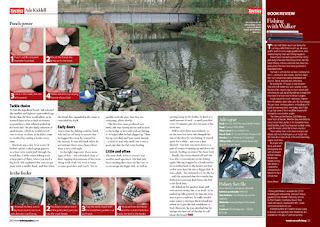
As you can see by the final feature, the 'grip-and-grin' of the angler with a fish made the opening spread, with sequences and incidentals over the remaining spread. Am I happy? Yes, and I know that my editing procedure ultimately influenced the images that made it into the feature. Job done :)


Wednesday, 9 May 2012

Peter

Peter by Pat MacInnes
Peter, a photo by Pat MacInnes on Flickr.

Took this today while out on a shoot in Essex at a trout fishery.

This is Peter, he's the fishery manager and a thoroughly nice bloke. Looks-wise he's a tad rough around the edges but as far as fishery staff go, he's one of the most welcoming I've met. Oh, and he also sound like Harry Hill.

EXACTLY like Harry Hill.

All I could think about was the knitted toy and people in crazy suits having fights on stage!!

*Nikon D2x
*Nikon 17-55mm f/2.8 AF-S
*ISO 100
*1/250th @ f/6.3
*SB-700 through softbox from camera left (power set to 1/8th)
*Processed in LR3

Monday, 16 April 2012

The Fishing Scientist

The Fishing Scientist by Pat MacInnes
The Fishing Scientist, a photo by Pat MacInnes on Flickr.

An old shot I unearthed while browsing my archive.

I took this during a trip to Berkley's Gulp bait factory in southern Holland. This was a press trip so there were all sorts of people who were trying to get shots of the chief scientist called Franz (or it could have been Frank - he dazzled me with science!).

Because of the melee of journos all wanting to get something for their mags, I had to work quickly so just set up an SB-800 in SU-4 mode behind him, with an SB-800 from camera right trigered by an Elinchrom Skyport. The shoot took about three minutes from start to finish before we headed out to the coach back to the airport.

Can't rememebr the settings but it was all manual obviously.

*Nikon D2x
*Nikon 12-24mm f/4
*ISO 200
*1/100th @ f/8

Although it did the job, this is the kind of shot I look back on and think "I wish I'd done it differently". The shot is fine in general and fitted what the mag wanted, but I know now that there needed to be more fill on the labels, the ambient needed to be dialled down in the background, and a gel on the rear flash could have given it more impact.

Still, it was true 'on-the-fly' indoor shooting, something I don't get a chance to do very often....

Sunday, 15 April 2012

Flatholm Island

Flatholm Island by Pat MacInnes
Flatholm Island, a photo by Pat MacInnes on Flickr.

Between massive thunderstorms and epic hail (and waiting for fish to bite) I thought I'd grab a shot of Flatholm, one of the islands that lie in the Bristol Channel.

*Nikon D2x
*Nikon 70-200mm f/2.8
*ISO 400
*1/4000th @ f/5.6

Friday, 30 March 2012

Nab Tower

Nab Tower by Pat MacInnes
Nab Tower, a photo by Pat MacInnes on Flickr.

Via Flickr:
I was out on a very long (18-hour) shoot today in the Solent, off the isle of Wight. The feature was to get stock images for Total Sea Fishing magazine aboard 'Wight Huntress'.

While steaming around we motored very close to the impressive Nab Tower, an anti-submarine instalment from WW1. It's a well-known point for sailors, denoting the deep water entrance to the Solent.

It's an impressive structure even if it does have a bit of a lean - covered in rust and against an azure blue sky it looked great, and although I originally envisioned a mono conversion would suit the detail in the iron work better, in colour it does have a certain impact.

More details about the tower - en.wikipedia.org/wiki/Nab_Tower

*Nikon D2x
*Nikon 17-55mm f/2.8
*ISO 100
*1/100th @ f/9
*Processed in Lightroom 3

Tuesday, 27 March 2012

Hustle & Bustle

Hustle & Bustle by Pat MacInnes
Hustle & Bustle, a photo by Pat MacInnes on Flickr.

Via Flickr:
This was taken at the NEC (national Exhibition Centre) during the recent FocusOnImaging2012 show, one of major photographic expos.

I go every year to have a play with new kit, buy some essentials and watch some great seminars from the major players.

This was taken in the main atrium outside the show at the end of the penultimate day. The NEC is totally a 1980s site and the design, although not something you'd say was classic, does have its interesting elements such as these brilliant ceiling windows.

Shot on my trusty HTC Desire HD, I just set it to a standard monochrome mode.

Tuesday, 20 March 2012

Blackbird

Blackbird by Pat MacInnes
Blackbird, a photo by Pat MacInnes on Flickr.

Via Flickr:
Another grab shot inbetween sections while out on a magazine shoot. To be fair, he helped me out a lot, being very obliging - probably waiting for a maggot or two to be thrown his way.

*Nikon D2x
*Nikon 70-200mm VR
*ISO 400
*1/100th @ f/3.5

Wednesday, 7 March 2012

Portrait of a Space Ranger

Via Flickr:
Visited Focus On Imaging at the NEC this week and saw some really good talks on lighting, especially those dealing with portraiture. Now, I won't say I'm great at portraiture but it was, when I was training, something I really got into and it's something I still love today even though I rarely get a chance to do any.

One of the speakers, Damien Lovegrove, gave a really interesting demo on achieving a hollywood-style, 1940s look using continuous lighting. His results were stunning with really simple lighting. I wasn't in the mood to get soft boxes and shoots out tonight so thought I'd try something using light painting with my phone. Only a slight crop and a bit of a vignette have been added.

I did some shots with really shallow depth-of-field but it just looked too out-of-focus and lacked detail in the eyes so I upped the f-stop to f/11, knowing there would still be enough drop-off to give it a look somewhere near what i wanted.

You'll have the excuse the marks and dink on Buzz's face - this is my little boy's toy so gets thrown around all over the shop. Anyway, it's just a bit a bit of fun and it keeps me going :)

*Nikon D2x
*Nikon 60mm macro AF-D
*ISO 100
*25secs @ f/11

Sunday, 4 March 2012

A Day On The Waves

Boats and me don't really mix so last week I wasn't quite looking forward to spending 12-hours out at sea. Thankfully, as if it was some special reprieve for a leap year (it was the 29th), we were graced with calm(ish) seas and at times, what felt like T-shirt weather!

Boats are a real challenge to shoot on. It's hard enough working in tight spaces on land, but doing it on a 10ft x 18ft boat deck that was rolling all over is even harder. Add in the fact you are limited on vantage points, and it's something that you quickly have to get used to.


"General shots like this demand a wide lens and getting your timing right not only to get thing level in the swell, but also the lighting and the position of the anglers."

I was out shooting for Total Sea Fishing magazine, a magazine I like working on if only because of the variety of destinations it takes me to. This day we were out of Newhaven, Sussex on the Carrick Lee skippered by Frank Shaw. Franks old Carrick Lee was a large double-hull that was massive, so it was a bit of a surprise to find that he'd changed to a smaller single-hulled boat. Immediately, I knew the majority of my shooting would be on the 14mm Sigma, although I was wishing I'd not sold my 10.5mm fisheye. On boats there's little need for anything longer than 50mm in reality.... it's a crowded workspace with bodies everywhere (plus equipment) and there are so few opportunities to shoot across the deck.

I'd brought a load of off-camera flash gear too, in the hope that I'd have an opportunity to create some funky lighting but again, too many moving bodies meant flashes could be obscured, plus the boat moves around so much in relation to the sun, the lighting is a nightmare; one minute you're shooting in full sun, the next you're shooting into it and having to power flash into the shadows. In the end I just decided to go with an on-camera SB-700. I shot some stiff on TTL but when it came to the catch shots I knew it'd be a bi quicker to set it to manual to quickly change the ambient/flash levels.

Anyway, steaming 25 miles out was a case of focussing and not letting the sickness kick in. The great thing about boat fishing is that you quickly have to bond with the people alongside you. I knew no one but the journalist with me (Barney Wright) and the skipper, who is a no-nonsense guy who speaks his mind and more often than norm has you in stitches.

Thankfully, and I won't bore you with the technical details, we caught a load of fish, mainly cod, with a 20lb 4oz fish falling to Barney's mate, Matt Todd. He was chuffed as is to be expected. I spent so long behind the lens that I only got about 30 minutes fishing in at the end of the day when the tide had slackened and it was pap.

"Matt Todd with his 20-pounder. Framed with a lot of space around the subject so we could possibly use this as a double-page spread (DPS). I also shot a portrait version for use on a single page or a cover."

Feature in the bag, we had a 90-minute steam back to port (we'd been steadily move back to shore through the day) so while the boys were doing the filleting - another bonus of these jobs is a lot of fresh fish for the pot - I got the 70-200mm out to try and get some shots of the gulls that were following the boat. It was fascinating to watch several species of gull all vying for the tit-bits thrown overboard. But at times, there seemed to be something that drew the birds alongside the boat, a bit like those films of dolphins you see in the wake of a speeding boat. They were hanging serenely in the air beside us, often close enough to have leapt out to touch even if there was 40-metres of water beneath! They were fascinating to watch and had me transfixed through the journey back. Safe to say, I rattled off about 8GB of raw shots but the birds' movement was so quick that much of the time it was impossible to track them properly. I probably had about 7.5GB of blurred, out of focus bird photos. I was out of my depth.


I managed to rattle a few good ones off after I realised a two-button reset was required to get my AF back to something useable - faffing around with settings should be left to the experts! I'm actually happy with the gull shots bearing in mind we were doing something like 15 knots. One even got entered into an online photo comp, although at the time of writing I'm not in the running.

On reflection, I loved the day and came away wanting to go out again soon. I love the banter on board, I love the photography challenges, and when it's not rocking and rolling, I love the feeling of freedom you only get when you're somewhere remote.